
Story 02 · The Promise of Mass Timber
Mass Timber Rising
Low-carbon, quick to construct, biophilic and cost competitive. These qualities have propelled mass timber construction into a formidable solution for the built environment across a wide array of building types. With global expertise and increasing manufacturing capacity, mass timber is a home-grown solution to decarbonizing our cities.

Chapter 1 of 4
What is Mass Timber?
The name might lead you to believe otherwise, so let’s be clear–mass timber construction does not use massive trees. Mass timber uses standard-dimensional lumber (2x6s and 2x8s) manufactured from commercial sawlogs to produce large structural panels and beams. Wood, being a natural material, comes with defects and variations; that’s what gives it character. But, defects introduce weak spots that are prone to failure. Mass timber is an engineered wood product that minimizes defects and variation by combining and optimizing many small pieces together. It offers great strength without having to cut large trees.
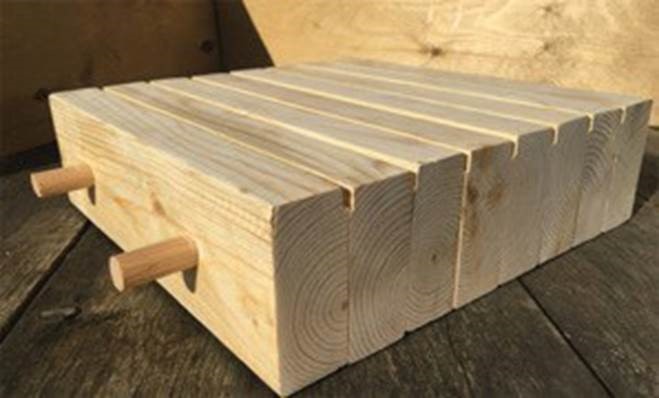
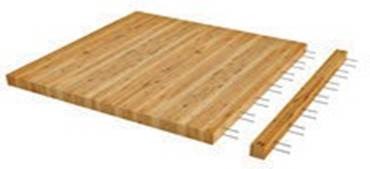
Mass timber is a catch-all term that describes a suite of engineered wood products including cross-laminated timber (CLT), nail-laminated timber (NLT), dowel-laminated timber (DLT) and glulam beams. These advanced wood products are all made with dimensional lumber. Mass plywood (MPP) is made using a similar process except it uses large sheets of veneer and can use logs as small as five inches in diameter. Mass timber products like CLT and MPP are not commodity products, but rather precision engineered industrial components that are prefabricated off-site.
According to North American Mass Timber, “CLT is a panelized structural engineered wood product that can be used in all major building components (floors, interior and exterior walls, and roofs). Mass plywood (MPP) is a structural panelized product that can be used in many similar applications.” Mass plywood has the advantage of being more efficient compared to cross laminated timber because it uses less raw material to achieve the same strength characteristics.

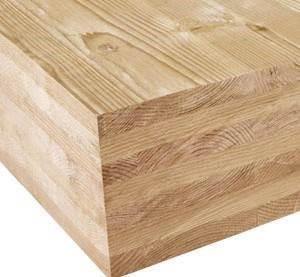
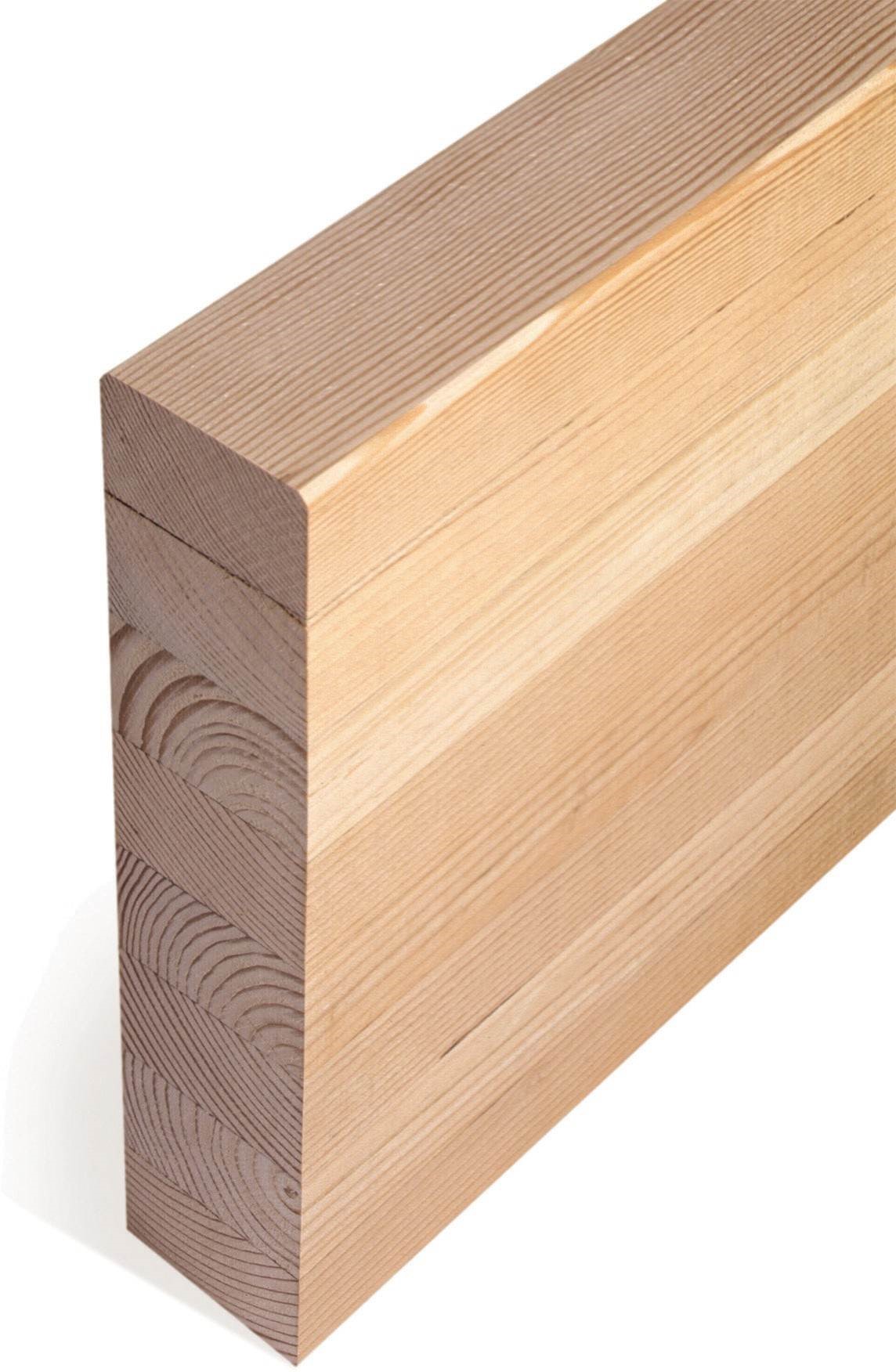
Cross-laminated timber (CLT) has been described as “plywood on steroids”. Plywood is composed of multiple layers of thin veneer laid at right angles, and pressed together with glue. The alternating layers give the material strength and rigidity. Any defect, like knot holes, are distributed evenly without compromising strength. Now, imagine a similar product made with alternating layers of 2x6s or 2x8s laid up into large panels and glued together. Just like plywood uses many small layers and combines it into a larger unit, CLT works the same way. Smaller boards (officially called “lamella”) are pressed into larger structural components, such as beams, walls and floors. CLT is pressed into large panels with up to nine layers. Dimensions are only limited by the size of the press and vehicles required to transport the product. The process is very efficient and enables the creation of large (mass) structural components with minimal defect and variation or the use of large ecologically-valuable trees.
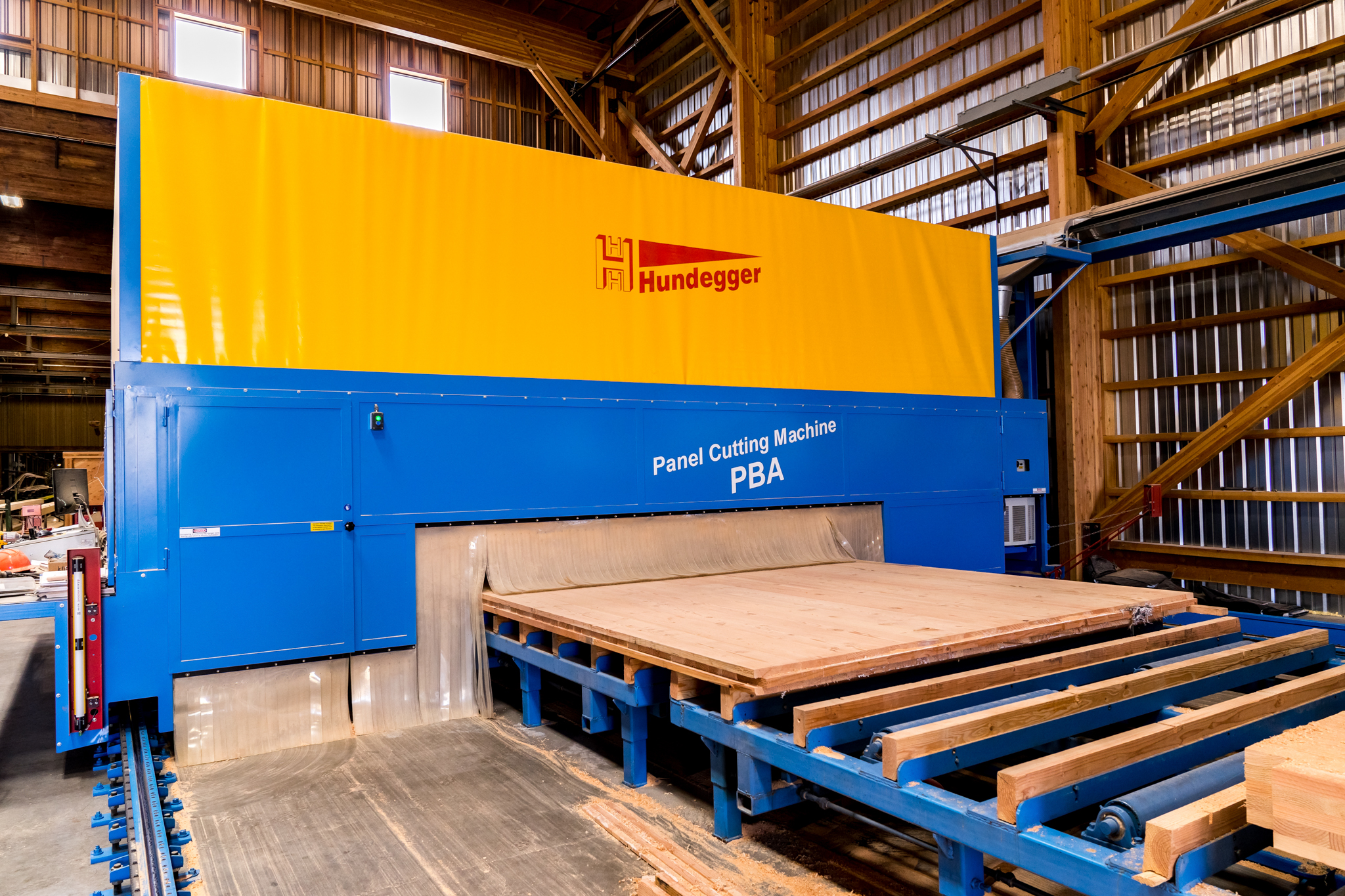
Unlike most standard residential “stick frame” construction, mass timber panels and beams are pre-fabricated at manufacturing plants with specialized equipment to exact specifications. A computer numerically controlled (CNC) router adds the necessary cut outs for doors, windows, fasteners, conduit, and utilities. Completed panels are then loaded onto trucks in their order of installation, which greatly increases and streamlines job site efficiency.
1Anderson, Atkins, Beck, Dawson and Gale (2020). North American Mass Timber 2020: State of the Industry. Forest Business Network.

Chapter 2 of 4
Tall Wood is Hot – Here’s Why
In the last few years, mass timber construction has emerged as one of the hottest construction trends in the U.S., and it’s only growing in popularity. According to North American Mass Timber1, from 2016 to 2019, the square footage of mass timber projects quadrupled in the U.S. Data from Woodworks shows that as of March 2021, the U.S. had 541 projects in construction and another 600 in design, which is twice the amount of the prior year. In addition to the number of new projects, mass timber has also been tapped as the building material of choice for some of the globe’s leading companies including Microsoft, Adidas, Google, and Walmart.

Given the long history of green building and wood products manufacturing in the Northwest, it’s not surprising that the region is a leader in the mass timber movement. With over 100 projects either built or in construction, and more than 60 in design, the mass timber construction community in the Northwest has evolved, building world-class expertise and experience.
Portland is also home to the International Mass Timber Conference whose growth reflects the rise of the mass timber industry. The first year of the event brought together over 500 people from a dozen countries. By 2021, the conference saw over 1,800 attendees and participation from 39 countries. This year’s event is expected to draw over 2,000 attendees from several dozen countries.
So, what’s driving the rise of mass timber construction in the Northwest? Its appeal integrates ecology and technology. Ecologically, wood is a natural, renewable material that brings warmth and beauty into the built environment. Technologically, mass timber construction uses an advanced prefabricated product that increases the speed of construction and lowers labor costs. Mass timber competes on both looks and price.
The Bottom Line
From the perspective of a developer, a building has got to pencil out. In many cities, developers and designers are starting to see that mass timber construction can improve a building’s bottom line through quicker lease up rates and lower vacancies. Given that mass timber buildings are approaching cost parity with traditional construction methods, this can make mass timber buildings more competitive.
“A lot of our clients are now starting to understand that mass timber leads to quicker leasing and fewer vacancies. We are proving that we can build these buildings for the same cost as other structural systems,” said Corey Martin, Architect at Hacker Architects.
Cost Effective
Mass timber construction can be described as a “kit of parts” designed and fabricated off-site and packaged in the order of installation. A truck arrives at the job site loaded with mass timber panels. Workers attach the panels to a crane and they are hoisted into place and installed in a matter of minutes. As the wood has already been machined to tight tolerances by computer controlled equipment, cutting and trimming at the job site is minimized. These attributes speed up the construction process and reduce some of the noise and traffic impacts during construction, which the neighbors undoubtedly appreciate.
“Mass timber buildings are really an assembly of a kit of parts and that speeds up construction. We have buildings that fully cover the mass timber but using it speeds up the build time,” noted Ethan Martin, of DCI Engineers.
Code Approved
Building codes are intended to ensure the health and safety of a building’s occupants. Codes are, by their nature, slow to change. Code changes are the product of significant technical review, testing, and evaluation at many levels. When the International Code Council (ICC) approved code changes to the 2021 edition of the International Building Code and the International Fire Code allowing for a prescriptive pathway for mass timber buildings up to 18 stories, it was as if mass timber came of age. But, each state has to adopt the code on their own.
Currently, four states have adopted the 2021 IBC code changes, allowing for mass timber construction up to 18 stories: Oregon, Washington, California and Utah. California adopted the new ICC codes in July of 2021. The City of Denver, Colorado also adopted the new ICC codes.
Prior to the new codes being approved in the US, developers wishing to build with mass timber above six stories had to get special approval from the building codes department. Without prescriptive codes, the approval process relies on performance-based design, which is generally thought to raise cost, increase time, and add real or perceived risk. As more states adopt the prescriptive codes for tall mass timber construction, the pace of adoption will pick up.
Connection to Nature/Biophilia
As cities grow and more people live and work in urban areas, people’s connections to nature can be difficult to maintain. Mass timber appeals, in part, because it brings the warmth and natural qualities of wood into the built environment. Dubbed “biophilic design,” the approach seeks to connect building occupants more closely to nature by incorporating natural lighting, ventilation, and natural materials (like plants and wood).
Intuitively, this design approach makes sense. Scientists are now quantifying that intuition. According to ThinkWood, “an Australian research firm surveyed 1,000 Australian workers and found a correlation between the presence of wood and employees’ overall satisfaction at work, lower absenteeism, higher levels of concentration, and improved productivity.”
The Northwest has a long history of building with wood and architects are excited about the unique possibilities of incorporating more wood into their buildings.
“Wood is this amazing material that comes from nearby that provides such a great opportunity to introduce warmth and beauty and tactile qualities and connection to nature into all aspects of our buildings whether it’s the exterior or the interior cladding or a ceiling. For me personally, it goes beyond that, it goes into the level of art,” noted Corey Martin, Hacker Architects.
Sustainability and Carbon Storage
“Carbon is a big issue for architects. Where does the wood come from and are the forests sustainably managed?” noted Judith Sheine, Co-Director of the TallWood Design Institute and University of Oregon’s School of Design.
Carbon is a big issue for architects and for all of us. The built environment accounts for approximately 40 percent of greenhouse gas emissions and wood products from sustainably managed forests are an increasingly important part of a climate solution. Because wood stores carbon and contains less embodied carbon than concrete and steel, companies seeking to build more sustainably are choosing to build with wood.
Just how important is the use of wood in sustainability? When Paul Schwer, President of PAE Consulting Engineers in Portland decided that their new corporate headquarters in Portland, Oregon would meet the lofty goals of the Living Building Challenge (generally considered to be the zenith of sustainable building design) they chose to build with wood.
“One of the biggest moves we could make on embodied carbon was to switch from a steel and concrete building essentially to a mass timber building,” said Paul Schwer, President of PAE consulting engineers.
The appeal of mass timber comes from its unique combination of low-carbon material and biophilic design while still competing on price and speed of construction.
1 Anderson, Atkins, Beck, Dawson and Gale (2020). North American Mass Timber 2020: State of the Industry. Forest Business Network.

Chapter 3 of 4
Making Cities Part of the Solution
Buildings are a climate problem; according to the World Green Building Council, buildings account for 39% of global carbon CO2 emissions: 28% from operational emissions (heating, cooling, keeping the lights on etc.) and the remaining 11% from material and construction1. Carbon dioxide emissions are the main drivers of global climate change.
This problem won’t go away on its own. Global population is expected to hit 8.5 billion by 2030 and the global building stock is expected to double in size by mid-century.
If buildings are a problem, can forests be the answer?
Forests store enormous amounts of carbon, most of it in living trees. The rise of mass timber construction is showing how cities can be a part of the climate solution by decreasing the carbon footprint of material used in buildings. This is where forests and wood products have an important role to play.
The vast forests of the Pacific Northwest are many things to many people. They are woven into the region’s history and cultural identity. They offer clean water, wildlife habitat, carbon storage, recreation, and they provide a diverse array of forest products. The forest sector remains an important economic force in the region, especially in rural communities.
Increasingly, forests are recognized and valued for their role in combating climate change by acting as vast carbon pools. Trees store carbon as they grow and release it when they die and decay. Wood is approximately fifty percent carbon and long-lived wood products store carbon throughout their useful life. The preeminent body on climate change, the International Panel on Climate Change (IPCC) recommends in the 4th Assessment Report that2,
“In the long term, a sustainable forest management strategy aimed at maintaining or increasing forest carbon stocks, while producing an annual sustained yield of timber, fiber, or energy from the forest, will generate the largest sustained mitigation benefit.”
Wood is one of the oldest and most widely used building materials. In the U.S. over 90 percent of all new houses are framed with wood and sheathed in plywood or other wood-based paneling.3 But now wood construction is going tall. Cities of the Northwest are at the vanguard of building tall wood buildings with mass timber.
The enthusiasm for mass timber construction is driven by both technology and ecology. Digital fabrication and advanced manufacturing enables wood buildings to rise to 18 stories more quickly and with less impact compared to traditional buildings. And as producing wood products takes far less energy than building with conventional, tall wood buildings can serve as important carbon stores. A second forest, if you will, rising into the skyline of our urban centers.
Built on a foundation of sustainable forestry, mass timber construction addresses the pressing need to transition the building industry toward renewable, biophilic wood construction that supports regional economies and healthy sustainable forests.
1Adams, M. et al. (2019, September). Bringing embodied carbon upfront. World Green Business Council. https://www.worldgbc.org/bringing-embodied-carbon-upfront-report-download.
2 IPCC (2007). Forestry. In Climate Change 2007: Mitigation. Contribution of Working Group III to the Fourth Assessment Report of the Intergovernmental Panel on Climate Change, Cambridge University Press, Cambridge, United Kingdom and New York, NY, USA.
3 Dietz, R. (2018, October). Framing Methods for Single-Family Homes: 2018. National Association of Home Builders, https://eyeonhousing.org/2019/10/framing-methods-for-single-family-homes-2018/
Chapter 4 of 4
Strong Start – Room to Grow
Mass timber construction reduces emissions from the built environment as more mass timber gets used in new tall buildings and retrofits of existing buildings. The carbon benefits accrue as mass timber becomes more widely adopted. However, if the trend loses steam and does not gain broader acceptance in the market, its climate gains will go unrealized.
So, let’s take a closer look.
Mass timber construction is a recent phenomenon in the U.S. According to WoodWorks, a non-profit organization that provides technical support for mass timber construction, less than 20 mass timber projects were initiated in 2014. Today, their numbers show that, as of June 2021 over 1,169 mass timber projects had been constructed or were in design. Importantly, new projects were occurring in all 50 states.
Can we expect the rapid expansion of mass timber to continue? Where will continued demand come from? At some point, will demand surpass manufacturing supply? The answer to these questions are important as the carbon storage and substitution potential of mass timber depends on new construction. If mass timber cannot compete with traditional building materials then its carbon storage and substitutions benefits will be limited.
But, predicting the future is notoriously tricky business. Thankfully, scientists have taken a detailed look at this question so we can leave the crystal ball behind and move into the admittedly, still murky, world of projections.
A recent peer-reviewed article from Brandt et al offers an up to date and detailed estimate of future demand for cross-laminated timber (CLT)1. The authors pulled a dataset used by utilities to forecast future power needs in the Northwest. The data provides historical and future projections of new residential and commercial buildings for Idaho, Montana, Oregon, and Washington. The authors worked backward from building estimates to gauge demand for mass timber and, correspondingly, required lumber supply.
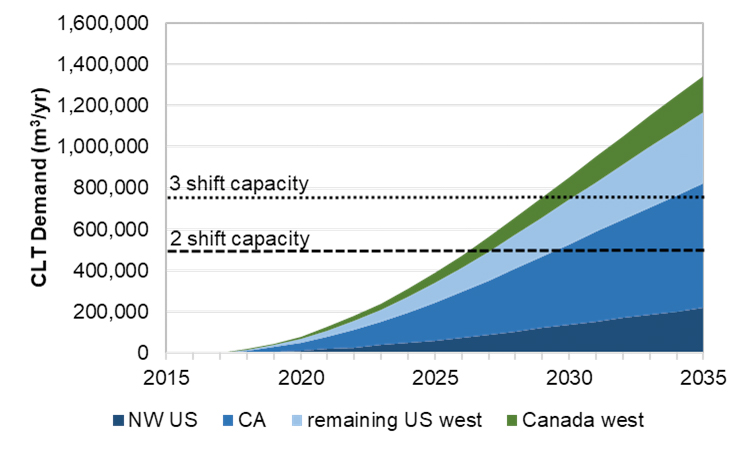
Combining the commercial building estimate with an exhaustive review of the literature, the authors concluded that demand for CLT in western North American would grow by approximately 24%. This figure aligns with research that found market penetration rates for CLT in Europe to be 30% fifteen years after introduction. The study notes that demand would be concentrated in large urban areas, with California accounting for more than half of the estimated demand in the western U.S.
Brandt and the co-authors examined a range of building types and determined that just over half, 54%, of the projected buildings would be suitable for CLT construction. They noted that CLT competes particularly well in mid-rise buildings (five to eight stories) and that CLT is a “superior financial choice at eight stories.”2
These estimates indicate that demand for CLT across the western U.S. could reach 800,000 m3 per year by 2030, which is approximately four-times the current 2020 volume of 209,000 m3 per year, according to the 2021 International Mass Timber Report.
So, how does the projection of new demand square up with existing and planned manufacturing capacity and lumber production?
The study also compares projected demand for CLT with existing lumber production in the western U.S. and Canada. Given the location of northern CLT producers such as Katerra and SmartLam North America, the inclusion of Canadian lumber is a logical choice.
In general, the study notes that existing CLT and MPP (mass plywood panels) facilities would be able to, “meet or surpass the western North American demand until at least 2026.” They also note that demand for the lumber grades most common to CLT production (#2 or better 2×6 and 2×8) could reach 10% by 2030 without adding additional facilities or capacity, which could impact lumber prices.
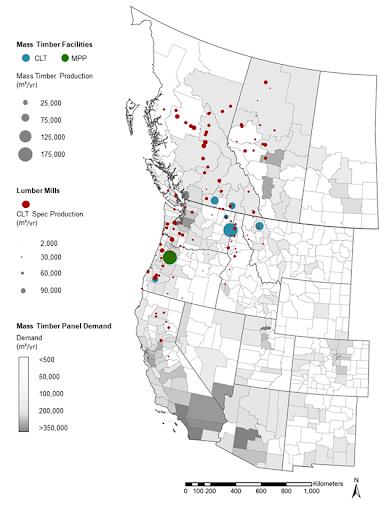
With six cross laminated timber facilities and one mass plywood facility in the Western U.S., the region has sufficient manufacturing capacity to service the expected 24% growth in mass timber demand in the upcoming decade.
Mass timber construction is off to a strong start and growth is expected to continue based on a solid value proposition and significant manufacturing capacity. These observations strengthen the contention that mass timber is a climate solution with considerable staying power.
1Brandt et al. (2021). “CLT demand and lumber supply,” BioResources 16(1), 862-881.
2Ibid.